Traditional RNA design starts from biology that is assumed rather than understood, and proceeds by trial and error. RNA-Logix™ discovers and characterizes the biology in house, then generates, ranks and validates designs against Therna’s own data, recursively.
Platform
Home »
RNA-Logix™ is an AI RNA Biologist that unlocks new biology and designs novel medicines
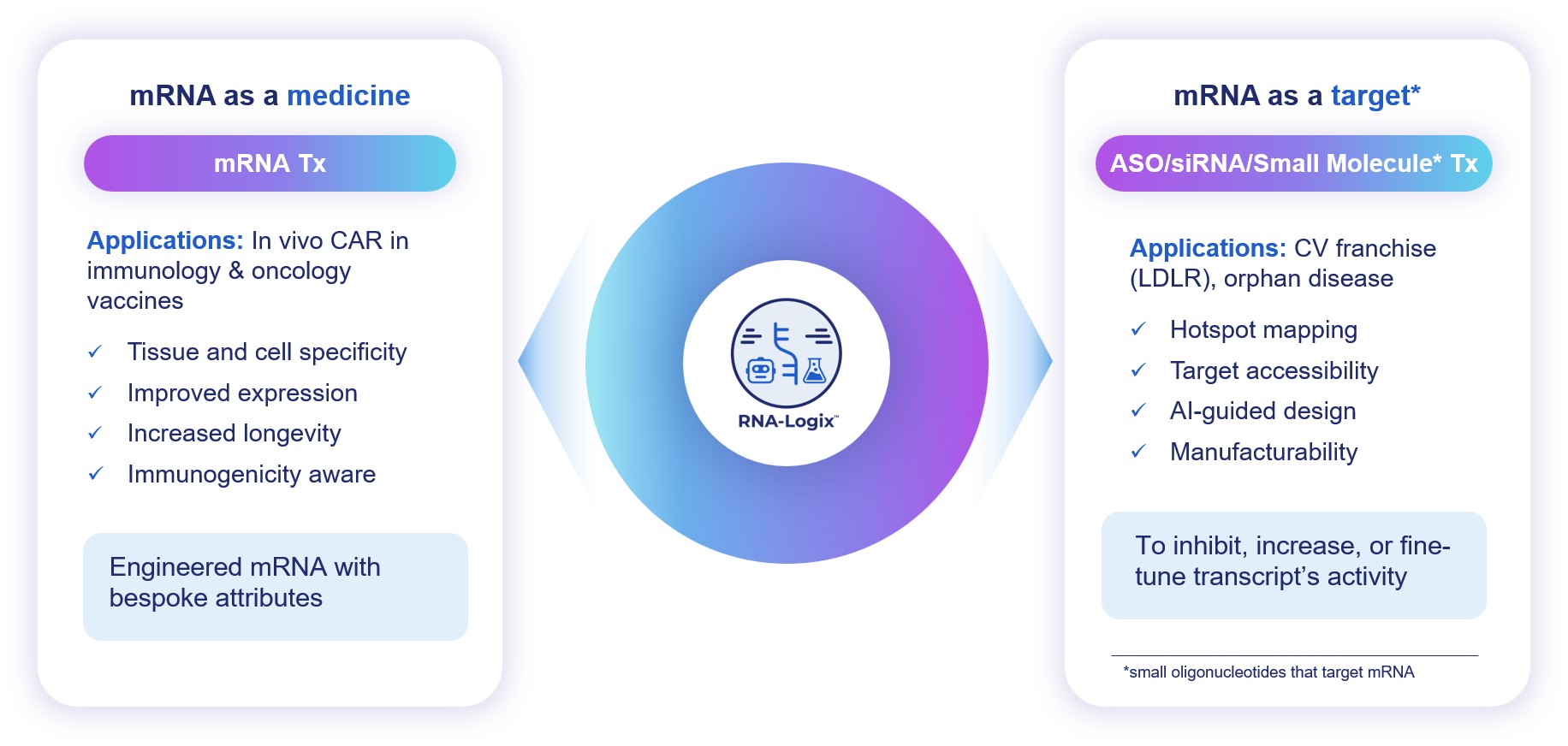
Two sides of the same strand: mRNA as medicine, mRNA as target
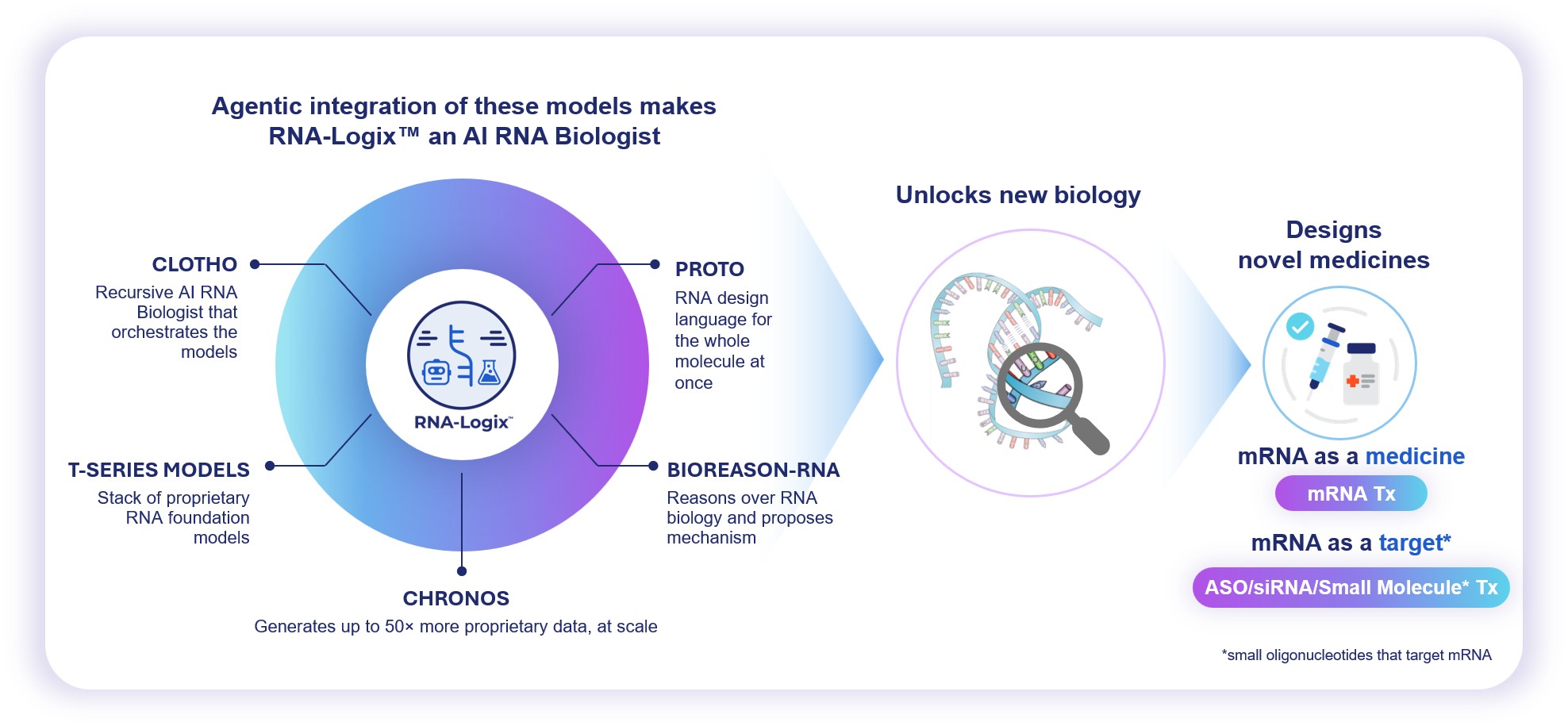
Inside RNA-Logix™
Chronos
Conventional methods measure one mRNA, in one cell type, at one moment. Chronos measures thousands of synthetic modified mRNAs across roughly 50 cell contexts and follows them over a multi-day window, in a single experiment. The data does not only scale. It resolves which RNA behaves how in which cell type, which is what makes it actionable for design.
T-Series
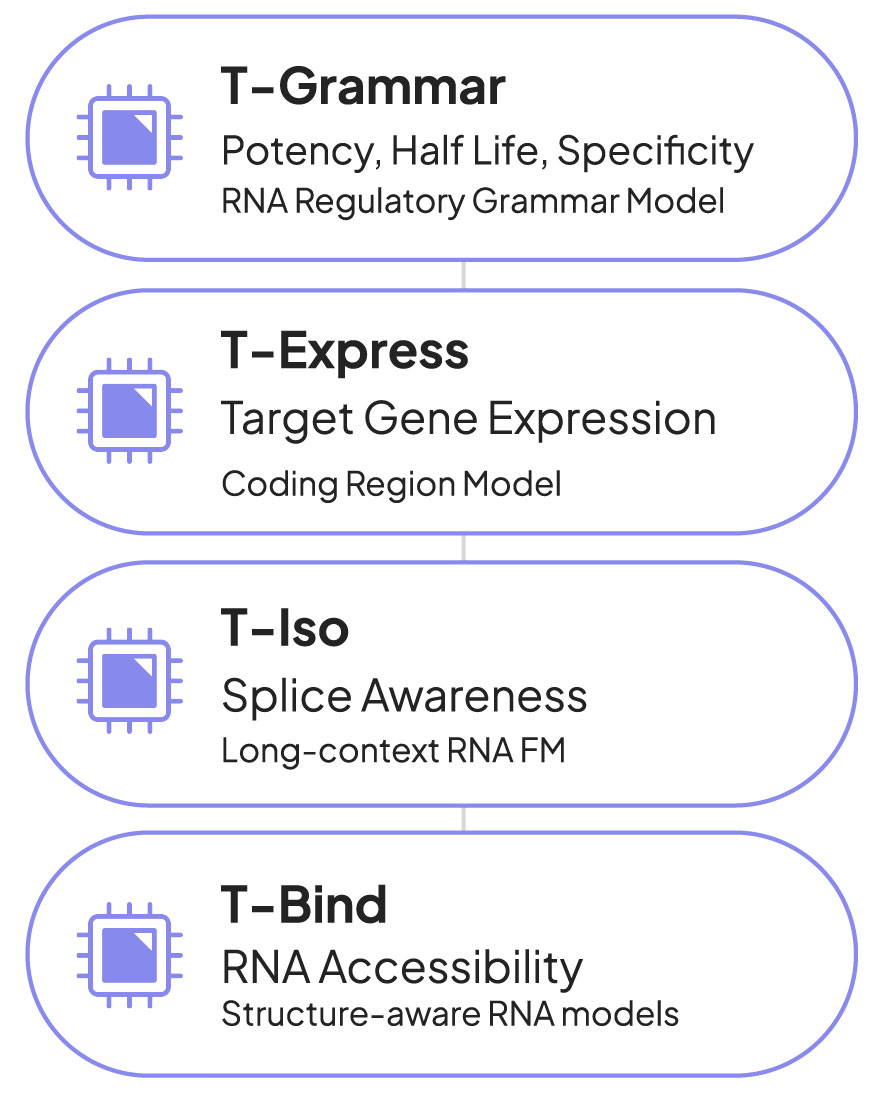
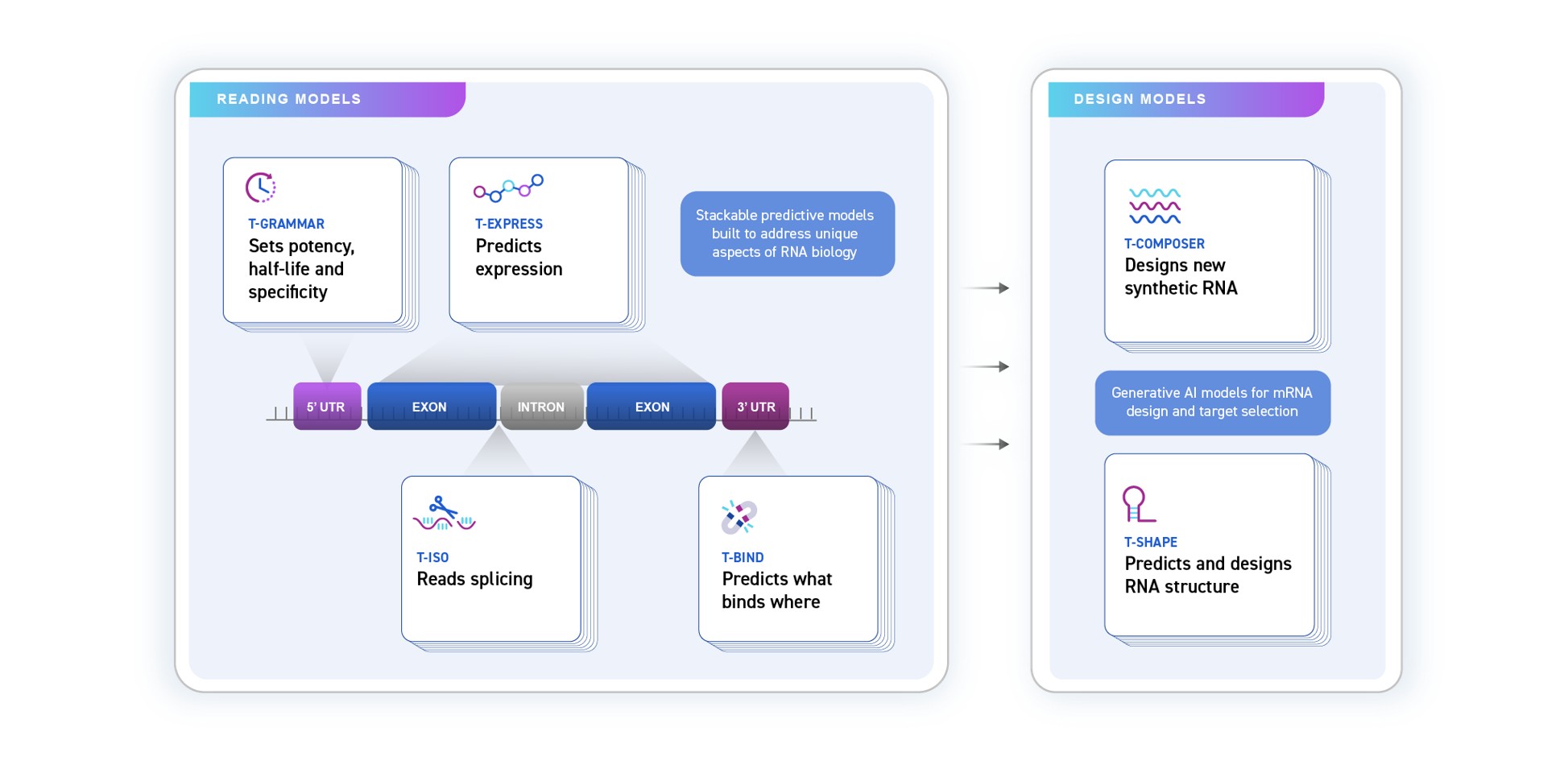
A stack of proprietary RNA foundation models trained on that data, each one reading and acting on a different axis of RNA biology: the untranslated regions, splicing, protein and RNA interactions, translation, structure, and synthetic design. Because the models are orthogonal, they compose, so everything they individually know can be built into one molecule.
Proto
Traditional RNA design optimizes one attribute at a time: the 5′ UTR, then the coding sequence, then the 3′ UTR, then immunogenicity. Proto is a design language that solves for all of them at once, drawing on the T-Series models to do it.
BioReason-RNA
The first reasoning model built from the ground up to reason over RNA. Ask it about a sequence and it works through the biology and shows its reasoning. The output that matters is not the answer. It is the visible chain of reasoning, because that chain is the proposed mechanism.
Clotho
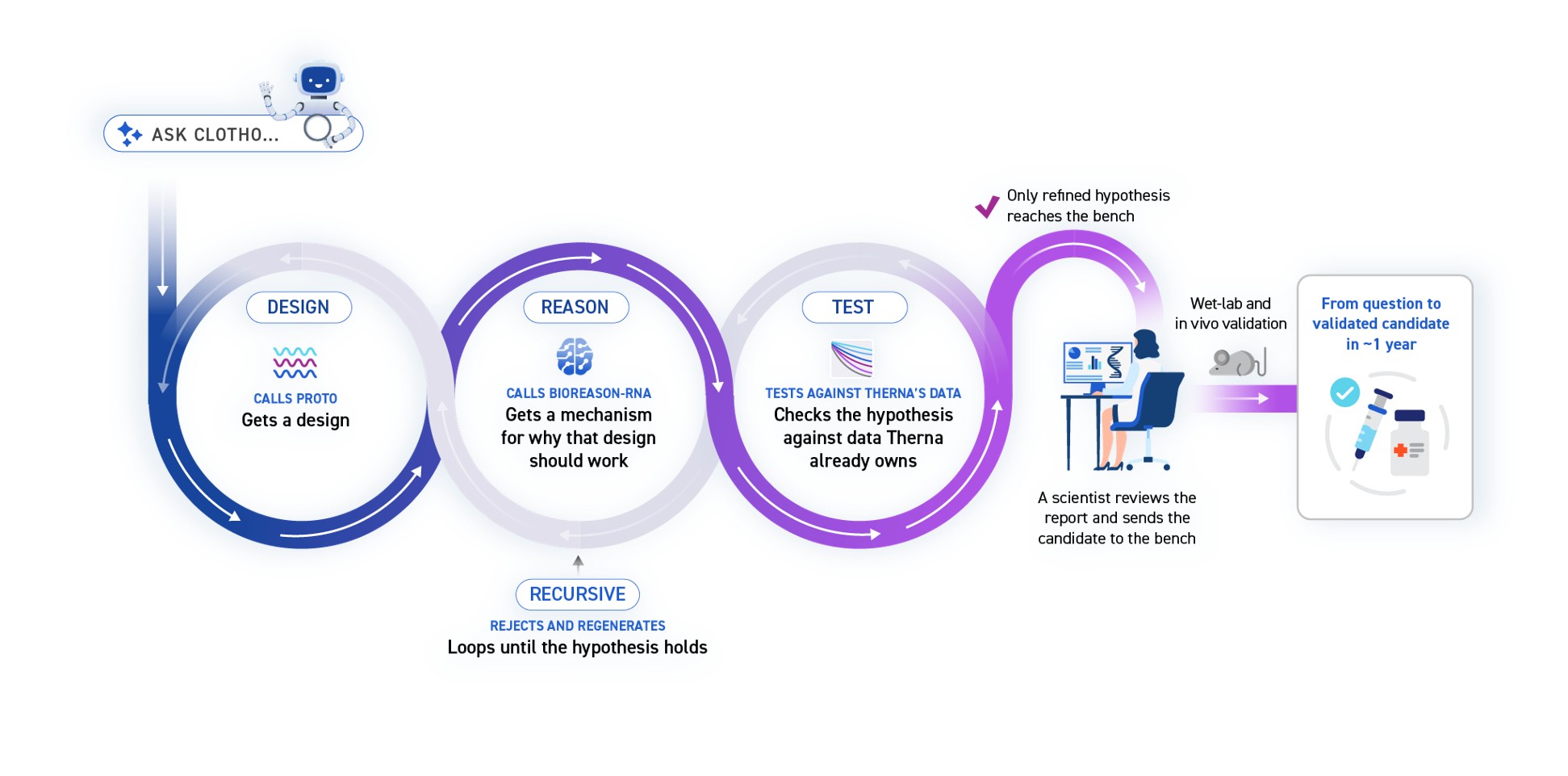
Clotho runs the loop. It calls Proto for designs, passes them to BioReason-RNA for mechanism, tests the resulting hypotheses against Therna’s own data, and refines until a hypothesis holds. Because Therna owns the data, a hypothesis can be tested without running a new experiment, so the candidates that reach the bench are far more refined. A scientist asks the question and a scientist receives the report.
The Only AI Platform Desgined for Both mRNA and ASO / siRNA Therapeutics
CONTEXT
RHA is studied in relation
to its environment

THERNA
MULTI-LAYERED DATA
Proprietary experimental data
generated to feed models

THERNA
FOUNDATION
BIOLOGY AI
Stackable predictive models built to
address unique aspects of RNA biology
THERNA
GENERATIVE AI FOR
RNA MEDICINE
Generative Al models for mRNA
design and Target Selection

OUTPUT
Testing and validation of our
de nevo designs

What RNA-Logix™ Designs
RNA-Logix designs mRNA as medicines, mRNA as targets
RNA-Logix™ Platform Capabilities
Discovers and characterizes the biology in house
Tests its own hypotheses against proprietary data, without a new experiment each cycle
The biology and a lab-validated candidate together in about a year
Every program feeds the platform that makes the next one faster
Programmable control of RNA behavior across modalities and diseases
The T-Series Models
mRNA
Therna’s T-Series models are trained on the proprietary data generated by Chronos to understand how mRNA sequence design influences translation, stability, immune response, and tissue and cell specificity. These models enable precise control over coding sequence optimization, allowing mRNA therapeutics to be precisely engineered for predictable and durable performance.
ASOs and siRNA
For antisense oligonucleotides (ASOs) and siRNA, Therna’s models identify optimal target sites and sequence features that drive effective silencing, upregulation, and fine-tuning of genes. By learning directly from functional RNA data, the platform supports rational design of ASO and siRNA therapies with improved potency, specificity, and consistency.
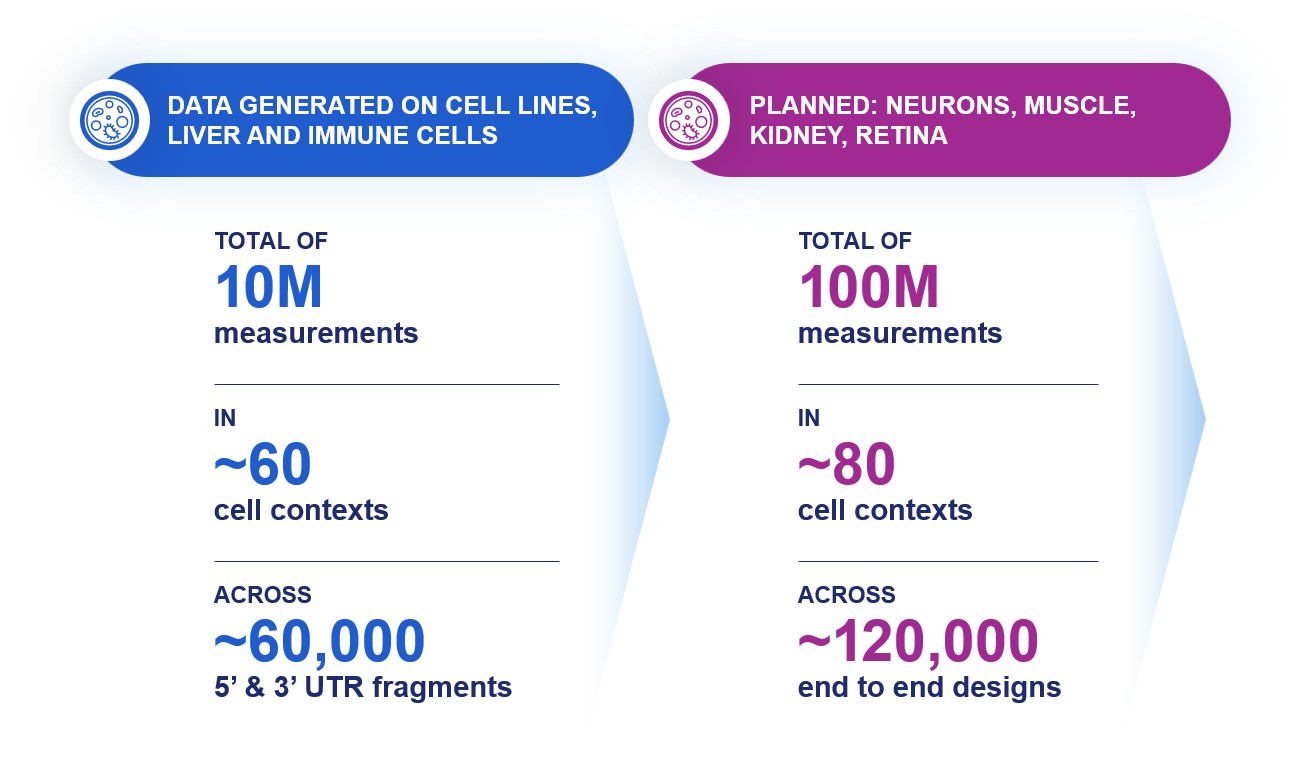
The Data Behind the Models
The largest proprietary RNA data set in the field
10M measurements
Roughly 60 cell contexts
Roughly 60,000 UTR fragments
Generated on cell lines, liver and immune cells, and scaling into neurons, muscle, kidney and retina.
The Recursive Loop
RNA-Logix™ designs, reasons through the biology, tests its own hypotheses against Therna’s proprietary data, and refines until a hypothesis holds. Because the Company generated that data itself, most of this loop runs without a new experiment, so the candidates that reach the bench are already far more refined than in conventional lab-in-the-loop approaches. What reaches the bench is validated in primary cells and in relevant in vivo preclinical models, and those results return to the models. Each program makes the next one faster.
RNA-Logix™ Platform
Understanding
RNA Medicines
Therna uses its proprietary RNA-Logix™ platform to design across the full spectrum of RNA medicines. Each modality offers a different way to influence biology.
Modality 01
mRNA
Messenger RNA carries instructions that direct cells to make a specific protein. It can be used to restore or boost a beneficial protein the body needs.
Modality 02
ASOs
Antisense oligonucleotides are short, single-stranded sequences that bind a target RNA to adjust how a gene is expressed, including dialing a protein down or, in Therna's differentiated approach, switching it up.
Modality 03
siRNAs
Small interfering RNAs are short, double-stranded sequences that selectively silence a target gene to reduce the production of a disease-causing protein.
Because ASOs and siRNAs act with high precision, they can reach disease drivers conventional drugs can't. By first unlocking the underlying biology, RNA-Logix™ learns where and how to intervene, then designs potential new medicines across all three modalities: mRNA, ASOs, and siRNAs.